Notes on Cryptohack

updating

Introduction to Cryptohack

1
2
3
_byte = chr(_integer)
_integer = ord(_byte)
# byte <=> acsii
1
2
3
_bytes = bytes.fromhex(_str)
_str = _bytes.hex()
# bytes <=> hex
1
2
_bytes = _str.encode("utf-8")
# str to bytes
1
2
3
4
5
6
7
8
9
10
import base64

_bytes = base64.b64encode(_bytes)
_bytes = base64.b64decode(_bytes)
# base64

custom_table = ""
std_table = "ABCDEFGHIJKLMNOPQRSTUVWXYZabcdefghijklmnopqrstuvwxyz0123456789+/"
_bytes = base64.b64decode(_bytes.translate(str.maketrans(custom_table, std_table)))
# hacked_base64
1
2
3
4
5
from Crypto.Util.number import *

_integer = bytes_to_long(_bytes)
_bytes = long_to_bytes(_integer)
# integer <=> bytes
1
2
_bytes = bytes(_integers)
# integers to btyes
1
2
3
4
5
6
from pwn import xor

_bytes = xor(A, B, [length])
# xor
# 自动匹配长度(扩展至length)
# 多类型支持(bytes/str/integer)

https://cryptohack.org/courses/intro/xorkey1/

根据提示,为已知明文攻击

plainkey=cipherplain \oplus key = cipher

key=plaincipherkey = plain \oplus cipher

根据泄露出来的b'crypto{'和密文

推出key前7位为myXORke

猜测完整key为myXORkey

1
2
3
4
5
6
7
8
9
10
11
from Crypto.Util.number import *
from pwn import xor

hex = 0x0e0b213f26041e480b26217f27342e175d0e070a3c5b103e2526217f27342e175d0e077e263451150104
b = long_to_bytes(hex)

key = b'myXORkey'

print(xor(b,key))

# crypto{1f_y0u_Kn0w_En0uGH_y0u_Kn0w_1t_4ll}

Modular Arithmetic


Extended Euclidean Algorithm

证明

由于 0ri+1<ri0 \le r_{i+1} < |r_i|rir_i 序列是一个递减序列,所以本算法可以在有限步内终止。又因为 ri+1=ri1riqir_{i+1} = r_{i-1} - r_i q_i(ri1,ri)(r_{i-1}, r_i)(ri,ri+1)(r_i, r_{i+1}) 的最大公约数是一样的,所以最终得到的 rkr_ka,ba, b 的最大公约数。

在欧几里得算法正确性的基础上,又对于 a=r0a=r_0b=r1b=r_1 有等式 asi+bti=rias_i + bt_i = r_i 成立(i=0i = 011)。这一关系由下列递推式对所有 i>1i > 1 成立:

ri+1=ri1riqi=(asi1+bti1)(asi+bti)qi=(asi1asiqi)+(bti1btiqi)=asi+1+bti+1r_{i+1} = r_{i-1} - r_i q_i = (as_{i-1}+bt_{i-1}) - (as_i+bt_i)q_i = (as_{i-1}-as_iq_i) + (bt_{i-1}-bt_iq_i) = as_{i+1}+bt_{i+1}

因此 sis_itit_i 满足裴蜀等式(sa+tb=gcdsa+tb=gcd),这就证明了扩展欧几里得算法的正确性。

Implementation

1
2
3
4
5
6
7
8
9
10
11
12
13
14
15
16
17
18
19
20
21
def ext_gcd(a,b):
prev_s,s = 1,0
prev_t,t = 0,1
prev_r,r = a,b
if b == 0:
return 1,0,a
while(r):
q = prev_r//r
prev_r, r = r, prev_r - q*r
prev_s, s = s, prev_s - q*s
prev_t, t = t, prev_t - q*t
return prev_s,prev_t,prev_r
# 递推

def ext_gcd(a, b):
if b == 0:
return a, 1, 0
else:
gcd, x, y = ext_gcd(b, a % b)
return gcd, y, x - (a // b) * y
# 递归

Fermat’s little theorem

若p为质数,有

apa(modp)a^p \equiv a \pmod{p}

若同时p不整除a,有

ap11(modp)a^{p-1} \equiv 1 \pmod{p}


quadratic residue

若在 Fp\mathbb{F}_p 中,有

r2=ar^2 = a

则称 aa 为 quadratic residue

±r\pm r 则为 aa 的两个根

Legendre’s Symbol:

判定条件(Euler’s Criterion):

(ap)={0if a0(modp)+1if a≢0(modp),quadratic residue1quadratic non-residue\left(\frac{a}{p}\right) = \begin{cases} 0 & \text{if } a \equiv 0 \pmod{p} \\ +1 & \text{if } a \not\equiv 0 \pmod{p}, \text{quadratic residue} \\ -1 & \text{quadratic non-residue}\end{cases}

Legendre’s Symbol

(ap)ap12(modp)\left( \frac{a}{p} \right) \equiv a^{ \frac{p-1}{2} } \pmod{p} , (ap){1,0,1}\left( \frac{a}{p} \right) \in \left\{1,0,-1\right\}

该符号具有积性,即

(mnp)(mp)(np)(modp)\left( \frac{mn}{p} \right) \equiv \left( \frac{m}{p} \right)·\left( \frac{n}{p} \right) \pmod{p}

1
pow(a, (p-1)//2, p) == 1

大于 2 的质数 mod 4 一共只有 1 和 3 两种情况:

p1(mod4)p \equiv 1 \pmod{4} 对应 p12\frac{p-1}{2} 为偶数,

p3(mod4)p \equiv 3 \pmod{4} 对应 p12\frac{p-1}{2} 为奇数

p3(mod4)p \equiv 3 \pmod{4} 时,可以通过如下公式快速算出root

1
root = pow(a, (p+1)//4, p)

证明

If p3(mod4)p \equiv 3 \pmod 4 then p+1p + 1 is divisible by 4. If we want to take the square root of a(modp)a \pmod p then:

(±ap+14)2ap+12ap1+22ap12+1ap12a(modp)(\pm a^{\frac{p+1}{4}})^2 \equiv a^{\frac{p+1}{2}} \equiv a^{\frac{p-1+2}{2}} \equiv a^{\frac{p-1}{2} + 1} \equiv a^{\frac{p-1}{2}} \cdot a \pmod p

But since aa was chosen to be a quadratic residue (otherwise it has no square roots) it follows that:

ap121(modp)a^{\frac{p-1}{2}} \equiv 1 \pmod p

And hence the two square roots of aa modulo pp can in this case be very easily computed as:

±ap+14\pm a^{\frac{p+1}{4}}

https://cryptohack.org/courses/modular/root1/

1
2
3
4
5
6
7
8
with open("output.txt",'r') as f:
exec(f.read())

for a in ints:
if pow(a, (p-1)//2, p) == 1:
r = pow(a, (p+1)//4, p)
flag = max(r,(r*(-1)%p))
print(flag)

p1(mod4)p \equiv 1 \pmod{4} 则复杂一些,通过Tonelli-Shanks解决

1
2
3
4
5
6
7
8
9
10
11
12
13
14
15
16
17
18
19
20
21
22
23
24
25
def tonelli_shanks(n, p):
q, s = p - 1, 0
while q % 2 == 0:
q //= 2
s += 1
z = 2
while pow(z, (p - 1) // 2, p) != p - 1:
z += 1
c = pow(z, q, p)
t = pow(n, q, p)
r = pow(n, (q + 1) // 2, p)
m = s
while t != 1:
temp = t
i = 0
for i in range(1, m):
temp = pow(temp, 2, p)
if temp == 1:
break
b = pow(c, 2**(m - i - 1), p)
m = i
c = pow(b, 2, p)
t = (t * c) % p
r = (r * b) % p
return r

Chinese Remainder Theorem


Adrien’s Signs

根据 a , p 可以算出 (ap)1(modp)\left( \frac{a}{p} \right) \equiv 1 \pmod{p}

则 a 为模 p 的二次剩余

根据legendre’s symbol的积性,有

(aep)=(ap)e=(1)e=1\left( \frac{a^e}{p} \right) = \left( \frac{a}{p} \right)^e = (1)^e = 1

这意味着对 e\forall e , 皆有 aea^e 为二次剩余

也就是说 ee 的取值不影响 aea^e 的legendre’s symbol

又根据欧拉准则的第一补充:

p3(mod4)p \equiv 3 \pmod{4} 时,有 (1p)=1\left( \frac{-1}{p} \right) = -1

就可以完成bit与legendre’s symbol的对应

1
2
3
4
5
6
7
8
9
10
11
12
13
14
15
16
17
18
from Crypto.Util.number import *

with open('output.txt','r') as f:
exec(f.read())

p = 1007621497415251
plain = ''

for c in cipher: # we name the list in output.txt 'cipher'
if pow(c, (p-1)//2 ,p) == 1:
plain += '1'
else:
plain += '0'

plain = long_to_bytes(int(plain,2))
print(plain)

# crypto{p4tterns_1n_re5idu3s}

Modular Binomials

利用二项式展开在模意义下的性质

(a+b)n=an+an1b1++a1bn1+bnan+bn(modab)(a+b)^n = a^n + a^{n-1}b^1 + \cdots + a^1b^{n-1} + b^n \equiv a^n+b^n \pmod{ab}

化简原式,再齐次化消掉 p ,获得只含 q 的表达式 X ,利用

q=gcd(X,N)q = gcd(X,N)

计算出q

1
2
3
4
5
6
7
8
9
10
with open('data.txt','r') as f:
exec(f.read())

from math import gcd

exp = e1*e2
X = (pow(5,exp,N)*pow(c1,e2,N)-pow(2,exp,N)*pow(c2,e1,N))%N
q = gcd(X,N)
p = N//q
print('crypto{'+f'{p},{q}'+'}')

Symmetric Cryptography


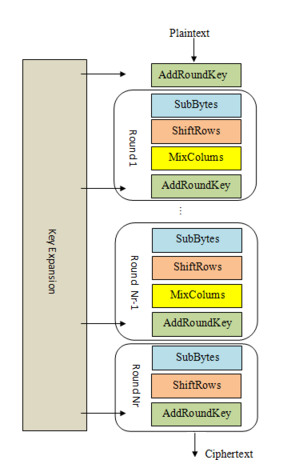
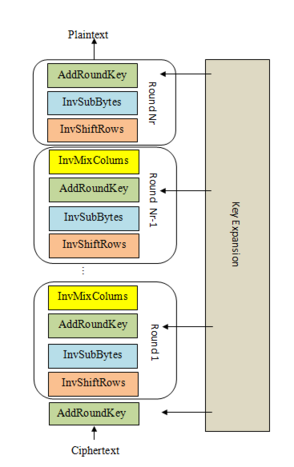
AES

  • Key Expansion (expand key to round_keys)

  • Add Round Key (add round_keys into the process through XOR)

  • Confusion (make it non-linear)

    • Sub Bytes (substitution the bytes through S-box)
  • Diffusion (spread the confusion)

    • Shift Rows

    • Mix Columns (matrix multiplication on GF(28)GF(2^8) field)

AES_encrypt
AES_decrypt

Bringing It All Together

1
2
3
4
5
6
7
8
9
10
11
12
13
14
15
16
17
18
19
20
21
22
23
24
25
26
27
28
29
30
31
32
33
34
35
36
37
38
39
40
41
42
43
44
45
46
47
48
49
50
51
52
53
54
55
56
57
58
59
60
61
62
63
64
65
66
67
68
69
70
71
72
73
74
75
76
77
78
79
80
81
82
83
84
85
86
87
88
89
90
91
92
93
94
95
96
97
98
99
100
101
102
103
104
105
106
107
108
109
110
111
112
113
114
115
116
117
118
119
120
121
122
123
124
125
126
127
128
129
130
131
132
133
134
135
136
137
138
139
140
141
142
143
144
145
146
147
148
149
150
151
152
153
154
155
156
157
158
159
160
161
162
163
164
165
166
167
168
169
def bytes2matrix(s):
return [list(s[i:i+4]) for i in range(0, len(s), 4)]

# AddRoundKey
def add_round_key(s,k):
for i in range(4):
for j in range(4):
s[i][j] ^= k[i][j]

# SubBytes

s_box = (
0x63, 0x7C, 0x77, 0x7B, 0xF2, 0x6B, 0x6F, 0xC5, 0x30, 0x01, 0x67, 0x2B, 0xFE, 0xD7, 0xAB, 0x76,
0xCA, 0x82, 0xC9, 0x7D, 0xFA, 0x59, 0x47, 0xF0, 0xAD, 0xD4, 0xA2, 0xAF, 0x9C, 0xA4, 0x72, 0xC0,
0xB7, 0xFD, 0x93, 0x26, 0x36, 0x3F, 0xF7, 0xCC, 0x34, 0xA5, 0xE5, 0xF1, 0x71, 0xD8, 0x31, 0x15,
0x04, 0xC7, 0x23, 0xC3, 0x18, 0x96, 0x05, 0x9A, 0x07, 0x12, 0x80, 0xE2, 0xEB, 0x27, 0xB2, 0x75,
0x09, 0x83, 0x2C, 0x1A, 0x1B, 0x6E, 0x5A, 0xA0, 0x52, 0x3B, 0xD6, 0xB3, 0x29, 0xE3, 0x2F, 0x84,
0x53, 0xD1, 0x00, 0xED, 0x20, 0xFC, 0xB1, 0x5B, 0x6A, 0xCB, 0xBE, 0x39, 0x4A, 0x4C, 0x58, 0xCF,
0xD0, 0xEF, 0xAA, 0xFB, 0x43, 0x4D, 0x33, 0x85, 0x45, 0xF9, 0x02, 0x7F, 0x50, 0x3C, 0x9F, 0xA8,
0x51, 0xA3, 0x40, 0x8F, 0x92, 0x9D, 0x38, 0xF5, 0xBC, 0xB6, 0xDA, 0x21, 0x10, 0xFF, 0xF3, 0xD2,
0xCD, 0x0C, 0x13, 0xEC, 0x5F, 0x97, 0x44, 0x17, 0xC4, 0xA7, 0x7E, 0x3D, 0x64, 0x5D, 0x19, 0x73,
0x60, 0x81, 0x4F, 0xDC, 0x22, 0x2A, 0x90, 0x88, 0x46, 0xEE, 0xB8, 0x14, 0xDE, 0x5E, 0x0B, 0xDB,
0xE0, 0x32, 0x3A, 0x0A, 0x49, 0x06, 0x24, 0x5C, 0xC2, 0xD3, 0xAC, 0x62, 0x91, 0x95, 0xE4, 0x79,
0xE7, 0xC8, 0x37, 0x6D, 0x8D, 0xD5, 0x4E, 0xA9, 0x6C, 0x56, 0xF4, 0xEA, 0x65, 0x7A, 0xAE, 0x08,
0xBA, 0x78, 0x25, 0x2E, 0x1C, 0xA6, 0xB4, 0xC6, 0xE8, 0xDD, 0x74, 0x1F, 0x4B, 0xBD, 0x8B, 0x8A,
0x70, 0x3E, 0xB5, 0x66, 0x48, 0x03, 0xF6, 0x0E, 0x61, 0x35, 0x57, 0xB9, 0x86, 0xC1, 0x1D, 0x9E,
0xE1, 0xF8, 0x98, 0x11, 0x69, 0xD9, 0x8E, 0x94, 0x9B, 0x1E, 0x87, 0xE9, 0xCE, 0x55, 0x28, 0xDF,
0x8C, 0xA1, 0x89, 0x0D, 0xBF, 0xE6, 0x42, 0x68, 0x41, 0x99, 0x2D, 0x0F, 0xB0, 0x54, 0xBB, 0x16,
)

inv_s_box = (
0x52, 0x09, 0x6A, 0xD5, 0x30, 0x36, 0xA5, 0x38, 0xBF, 0x40, 0xA3, 0x9E, 0x81, 0xF3, 0xD7, 0xFB,
0x7C, 0xE3, 0x39, 0x82, 0x9B, 0x2F, 0xFF, 0x87, 0x34, 0x8E, 0x43, 0x44, 0xC4, 0xDE, 0xE9, 0xCB,
0x54, 0x7B, 0x94, 0x32, 0xA6, 0xC2, 0x23, 0x3D, 0xEE, 0x4C, 0x95, 0x0B, 0x42, 0xFA, 0xC3, 0x4E,
0x08, 0x2E, 0xA1, 0x66, 0x28, 0xD9, 0x24, 0xB2, 0x76, 0x5B, 0xA2, 0x49, 0x6D, 0x8B, 0xD1, 0x25,
0x72, 0xF8, 0xF6, 0x64, 0x86, 0x68, 0x98, 0x16, 0xD4, 0xA4, 0x5C, 0xCC, 0x5D, 0x65, 0xB6, 0x92,
0x6C, 0x70, 0x48, 0x50, 0xFD, 0xED, 0xB9, 0xDA, 0x5E, 0x15, 0x46, 0x57, 0xA7, 0x8D, 0x9D, 0x84,
0x90, 0xD8, 0xAB, 0x00, 0x8C, 0xBC, 0xD3, 0x0A, 0xF7, 0xE4, 0x58, 0x05, 0xB8, 0xB3, 0x45, 0x06,
0xD0, 0x2C, 0x1E, 0x8F, 0xCA, 0x3F, 0x0F, 0x02, 0xC1, 0xAF, 0xBD, 0x03, 0x01, 0x13, 0x8A, 0x6B,
0x3A, 0x91, 0x11, 0x41, 0x4F, 0x67, 0xDC, 0xEA, 0x97, 0xF2, 0xCF, 0xCE, 0xF0, 0xB4, 0xE6, 0x73,
0x96, 0xAC, 0x74, 0x22, 0xE7, 0xAD, 0x35, 0x85, 0xE2, 0xF9, 0x37, 0xE8, 0x1C, 0x75, 0xDF, 0x6E,
0x47, 0xF1, 0x1A, 0x71, 0x1D, 0x29, 0xC5, 0x89, 0x6F, 0xB7, 0x62, 0x0E, 0xAA, 0x18, 0xBE, 0x1B,
0xFC, 0x56, 0x3E, 0x4B, 0xC6, 0xD2, 0x79, 0x20, 0x9A, 0xDB, 0xC0, 0xFE, 0x78, 0xCD, 0x5A, 0xF4,
0x1F, 0xDD, 0xA8, 0x33, 0x88, 0x07, 0xC7, 0x31, 0xB1, 0x12, 0x10, 0x59, 0x27, 0x80, 0xEC, 0x5F,
0x60, 0x51, 0x7F, 0xA9, 0x19, 0xB5, 0x4A, 0x0D, 0x2D, 0xE5, 0x7A, 0x9F, 0x93, 0xC9, 0x9C, 0xEF,
0xA0, 0xE0, 0x3B, 0x4D, 0xAE, 0x2A, 0xF5, 0xB0, 0xC8, 0xEB, 0xBB, 0x3C, 0x83, 0x53, 0x99, 0x61,
0x17, 0x2B, 0x04, 0x7E, 0xBA, 0x77, 0xD6, 0x26, 0xE1, 0x69, 0x14, 0x63, 0x55, 0x21, 0x0C, 0x7D,
)

def sub_bytes(s, sbox):
for i in range(4):
for j in range(4):
s[i][j] = sbox[s[i][j]]

# ShiftRows

def shift_rows(s):
s[0][1], s[1][1], s[2][1], s[3][1] = s[1][1], s[2][1], s[3][1], s[0][1]
s[0][2], s[1][2], s[2][2], s[3][2] = s[2][2], s[3][2], s[0][2], s[1][2]
s[0][3], s[1][3], s[2][3], s[3][3] = s[3][3], s[0][3], s[1][3], s[2][3]


def inv_shift_rows(s):
s[0][1], s[1][1], s[2][1], s[3][1] = s[3][1], s[0][1], s[1][1], s[2][1]
s[0][2], s[1][2], s[2][2], s[3][2] = s[2][2], s[3][2], s[0][2], s[1][2]
s[0][3], s[1][3], s[2][3], s[3][3] = s[1][3], s[2][3], s[3][3], s[0][3]

# MixColumns

xtime = lambda a: (((a << 1) ^ 0x1B) & 0xFF) if (a & 0x80) else (a << 1)

def mix_single_column(a):
t = a[0] ^ a[1] ^ a[2] ^ a[3]
u = a[0]
a[0] ^= t ^ xtime(a[0] ^ a[1])
a[1] ^= t ^ xtime(a[1] ^ a[2])
a[2] ^= t ^ xtime(a[2] ^ a[3])
a[3] ^= t ^ xtime(a[3] ^ u)


def mix_columns(s):
for i in range(4):
mix_single_column(s[i])


def inv_mix_columns(s):
for i in range(4):
u = xtime(xtime(s[i][0] ^ s[i][2]))
v = xtime(xtime(s[i][1] ^ s[i][3]))
s[i][0] ^= u
s[i][1] ^= v
s[i][2] ^= u
s[i][3] ^= v

mix_columns(s)


N_ROUNDS = 10

key = b'\xc3,\\\xa6\xb5\x80^\x0c\xdb\x8d\xa5z*\xb6\xfe\\'
ciphertext = b'\xd1O\x14j\xa4+O\xb6\xa1\xc4\x08B)\x8f\x12\xdd'


def expand_key(master_key):
"""
Expands and returns a list of key matrices for the given master_key.
"""

# Round constants https://en.wikipedia.org/wiki/AES_key_schedule#Round_constants
r_con = (
0x00, 0x01, 0x02, 0x04, 0x08, 0x10, 0x20, 0x40,
0x80, 0x1B, 0x36, 0x6C, 0xD8, 0xAB, 0x4D, 0x9A,
0x2F, 0x5E, 0xBC, 0x63, 0xC6, 0x97, 0x35, 0x6A,
0xD4, 0xB3, 0x7D, 0xFA, 0xEF, 0xC5, 0x91, 0x39,
)

# Initialize round keys with raw key material.
key_columns = bytes2matrix(master_key)
iteration_size = len(master_key) // 4

# Each iteration has exactly as many columns as the key material.
i = 1
while len(key_columns) < (N_ROUNDS + 1) * 4:
# Copy previous word.
word = list(key_columns[-1])

# Perform schedule_core once every "row".
if len(key_columns) % iteration_size == 0:
# Circular shift.
word.append(word.pop(0))
# Map to S-BOX.
word = [s_box[b] for b in word]
# XOR with first byte of R-CON, since the others bytes of R-CON are 0.
word[0] ^= r_con[i]
i += 1

# XOR with equivalent word from previous iteration.
word = bytes(i^j for i, j in zip(word, key_columns[-iteration_size]))
key_columns.append(word)

# Group key words in 4x4 byte matrices.
return [key_columns[4*i : 4*(i+1)] for i in range(len(key_columns) // 4)]


def decrypt(key, ciphertext):
round_keys = expand_key(key) # Remember to start from the last round key and work backwards through them when decrypting
# Convert ciphertext to state matrix
s = bytes2matrix(ciphertext)
# Initial add round key step
add_round_key(s, round_keys[N_ROUNDS])
# Do rounds
for i in range(N_ROUNDS - 1, 0, -1):
inv_shift_rows(s)
sub_bytes(s,inv_s_box)
add_round_key(s,round_keys[i])
inv_mix_columns(s)

# Run final round (skips the InvMixColumns step)
inv_shift_rows(s)
sub_bytes(s,inv_s_box)
add_round_key(s,round_keys[0])
# Convert state matrix to plaintext
plaintext = ''.join(chr(b) for r in s for b in r)
return plaintext


print(decrypt(key, ciphertext))
# crypto{MYAES128}

常见魔改点

  • S-box

  • MixColumns 系数矩阵

  • Rcon


ECB Oracle

ECB 逐字节攻击

依据ECB独立block加密的性质,通过用任意字符填充"plaintext"把flag挤到后面去,使得某一block的最后一个byte是想要泄露的flag字节

发送http请求来获得当前padding的标准密文

再在字符集里枚举字符,补上flag目标字节的位置,获取密文

若两段密文目标block完全相同,则当前枚举的字符就是flag目标字节

1
2
3
4
5
6
7
8
9
10
11
12
13
14
15
16
17
18
19
20
21
22
23
24
25
26
27
28
29
30
import requests
import string

URL = "https://aes.cryptohack.org/ecb_oracle/encrypt/"
session = requests.Session()

def encrypt(s, block):
hex = s.encode().hex()
url = f'{URL}{hex}/'
ret = session.get(url).json()['ciphertext']
return ret[block*32:(block+1)*32]

charset = '}@_-?!#' + string.ascii_letters + string.digits
flag = 'crypto{'

for i in range(7, 16*4):
padding = (31 - i % 16) * 'A'
block = i // 16 + 1
std = encrypt(padding, block)
for c in charset:
payload = padding + flag + c
exp = encrypt(payload, block)
if std == exp:
flag += c
break
if flag[-1] == '}':
break

print(flag)
# crypto{p3n6u1n5_h473_3cb}